Introduction To Gojek Clone App Development in 2026
Super Apps like Gojek have changed the rules of the game. These platforms proved that users don’t want ten different apps for ten different services. They want one powerful app that handles rides, food, deliveries, payments, and home services in a few taps. That shift has pushed global demand for structured Gojek Clone App Development to an all-time high.
Now let’s talk about 2026. Customers expect speed. They expect personalization. And they expect everything to “just work.” If you are planning Gojek Clone App Development in 2026, you are not just building an App, you are building a digital ecosystem that can scale, adapt, and grow with your market.
Why Gojek Clone for On-Demand 2026?
First things first, convenience always wins, like always. People do not need different Apps for different needs. And mostly they do not want to switch between multiple apps for food, parcel delivery, groceries, medical service, payments or more. When you build an Gojek Clone App, you are creating a multi-service business that encourages repeat usage and cross-selling.
The real advantage for you is that instead of earning from one service, you generate revenue from multiple verticals like commissions, subscription plans, advertising, and more. That’s smart business. In 2026, the Gojek Clone App Development is not experimental anymore. But it is strategic.
Must-Have Gojek Clone Features in 2026
If you want to compete seriously, your platform needs basic and advanced features. Below are the Gojek Clone Features 2026 that users expect by default today:
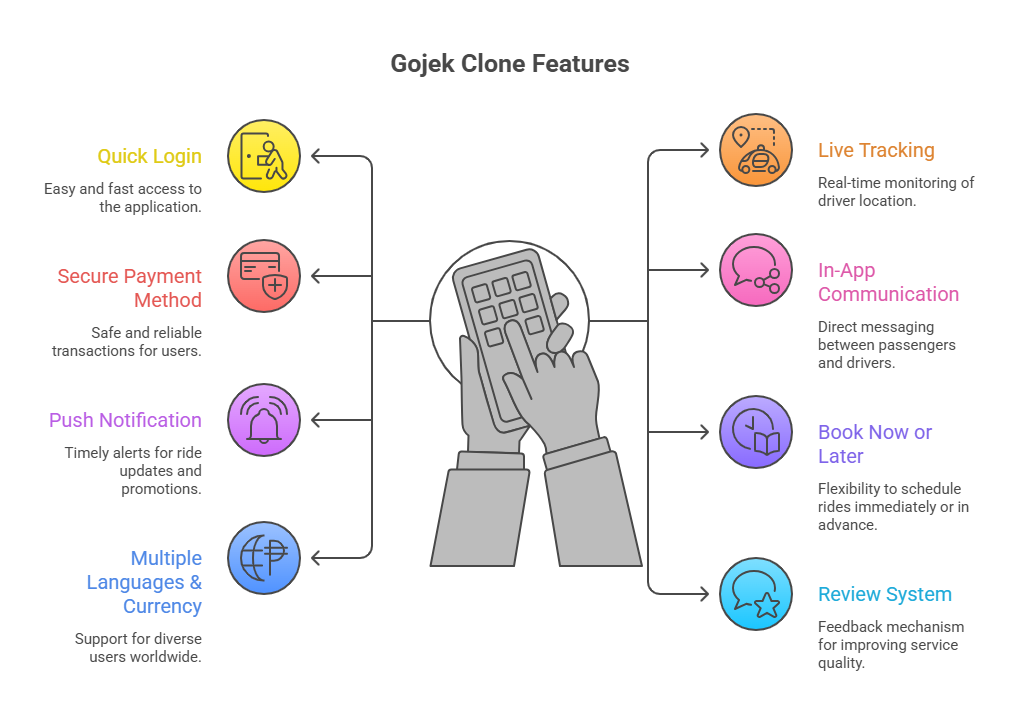
- Quick Login
Users can login quickly with their social media accounts or phone numbers. After they can set fingerprint or facial recognition for one-step login to use the App again.
- Live Tracking
User can track their booking, order, or service provided live with an accurate Estimated Time of Arrival. This will be available once the user’s service booking is confirmed.
- Secure Payment Method
The app supports multiple payment methods such as credit card, debit card, digital wallets, split payments, and cash. A smooth payment experience increases trust.
- In-App Communication
Users can talk inside the App through the in-app communication function. It lets users chat, voice call or video call the service provide.
- Push Notification
Send users personalised notifications about the bookings and offers, and catch their attention. Also, send a notification about the status update to the service booked.
- Book Now or Later
Users have the option to book the service on the spot or schedule of later time and date. In other words, they can book services in advance for their own comfort.
- Multiple Languages & Currency
Give the users the chance to choose the preferred language or currency for their comfort. Integrate multiple languages and currencies in the App.
- Review System
Let users leave proper feedback about the service they have opted for. They can review and rate the service, deliver, and service providers.
AI Features in Gojek Clone App Development in 2026
In 2026, AI is not “nice to have.” It is the current flowing demand. Every on-demand application must be integrated with built-in smart systems. The following are the AI features recommended for you to put inside your App:
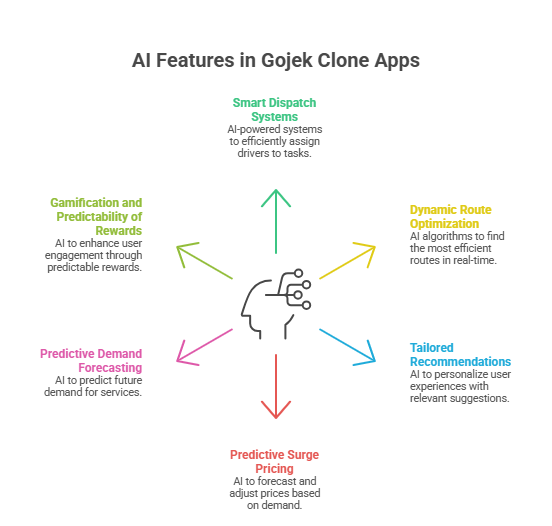
- Smart Dispatch Systems
In place of manually choosing the taxi ride, the AI chooses the nearest and most suitable taxi driver with respect to the traffic, ratings, and availability. This reduces the time wastage and improves productivity.
- Dynamic Route Optimisation
The AI is also able to analyse traffic routes and jamming in the roads to propose the fastest route in real time. Delays from orders do not mean happy users.
- Tailored Recommendations
The services that your app suggests might be based on past orders, history, and usage. Personalisation improves online order rate and online shopping value.
- Predictive Surge Pricing
AI is not reactive, but proactive, meaning it predicts demand even before it occurs. You can proactively change pricing and driver incentives.
- Predictive Demand & Operational Forecasting
Know in advance where the demand is going to rise. This will help you to be more strategic in allocating drivers and incentive plans.
- Gamification and Predictability of Rewards
AI identifies its users and drives that can stop using your platform and automatically offers them individual incentives to remain there.
Gojek Clone Pricing in 2026
There is one question that most entrepreneurs are asking: What does gojek clone cost really look like? It is up to your development strategy.
White-Label / Clone Script Model
It is a very functional and low-cost solution for startups and MSMEs.
- Basic Version: Around $10,000 to $18,000. Premise ride-hailing and delivery modules, an administration panel, and branding.
- Premium Version: $20,000 to $35000. It has multi-service integration, a wallet system, AI dispatch functionality, and marketing tools.
The model has a lower risk level and can be implemented within 24 to 40 weeks, which is a low barrier to entry into the market of super apps.
Custom Development Model
Custom development is very flexible and costs more.
- Per Hour Development Cost (2026 Average):
- Offshore Teams: $30 to $70/hour
- US/Europe Teams: $90 to $160/hour
Project Cost Range:
- Basic Super App: $70,000 to $130,000
- Advanced AI-Driven Super App: $180,000 to $350,000+
- Custom development could require 6 to 12 months, as per the complexity.
Major Factors of the Cost of Gojek Clone App Development
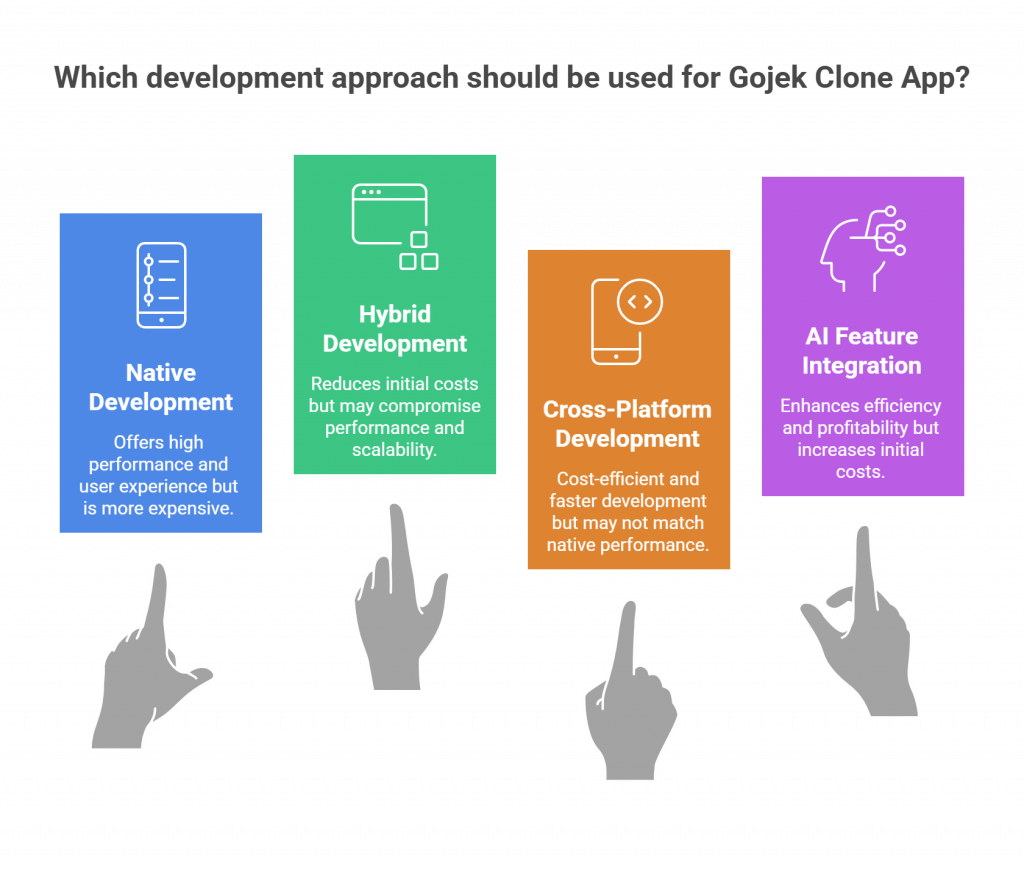
Native App Development
Native development involves the creation of Android and iOS apps using platform-specific languages. It is more efficient in terms of high performance and user experience.
Hybrid App Development
The hybrid development is the use of web technologies in developing a single application that is run on more than one system. It reduces initial construct expenses at the cost of minimising performance and scalability of advanced features in complex super apps.
Cross-Platform Development
Cross-platform development involves the creation of a single codebase (Android and iOS) through the use of frameworks such as Flutter. It provides cost-efficient performance as well as less time to develop, as compared to fully native solutions.
AI Feature Integration
Integration of AI would entail the deployment of predictive analytics, smart dispatch, and automated pricing systems. These emerging technologies add to the initial development expenses. Moreover, it enhances the efficiency of operations and profitability over time.
Tech Stack in the Current Gojek Clone Solutions
A trustworthy tech stack will provide security, scalability, and high throughput. The most common ready-made solutions in the market apply the following technologies:
Backend
Programmed with solid structures such as PHP and scalable Node.js services, designed around a micro services architecture to enable different modules of services to work effectively.
Frontend (User & Provider Apps)
Written in Flutter to support cross-platform applications, with Swift (iOS) and Kotlin (Android) to provide native application performance where needed.
Database
Uses MySQL to manage structured data and optimised caching mechanisms in order to support large volumes of transactions.
Real-Time Communication
Driven by Socket-based architecture and Firebase Cloud Messaging (FCM) to deliver instant notifications and live updates.
APIs & Integrations
Combined with Google Maps API to track, various payment gateway API to transact worldwide, and an SMS gateway to verify OTP.
Cloud and Hosting infrastructure
Its scalability and cloud based baeture are provided using Amazon Web Services (AWS). It included auto-scaling, load balancing, and CDN functionality to guarantee worldwide performance and availability.
This technology stack makes sure that the development projects of gojek clone app will be future-proof and can sustain large-scale operations.
Pre-Development Checklist
It is important not to overlook this part. These are some of the strategic questions to be answered first before deciding on a Gojek clone app development company.
1. Market Positioning
Who are you specifically attacking? Urban professionals? Suburban families? Emerging economies? Consider:
- Competitor analysis
- Demand gaps
- Local pricing trends
- User behaviour insights
- Unique selling proposition
- Readability is cost-saving in the future.
2. Plan Your Business Model
How do you plan to earn money on a regular basis? Think about:
- Commission percentages
- Subscription models
- Delivery charges
- Surge rules
- Feature listing
Before coding occurs, revenue planning is to be done.
3. Pre-Launch & Launch Marketing
An excellent product that lacks marketing is not seen. Focus on:
- Referral campaigns
- Influencer tie-ups
- Driver onboarding bonuses
- Social media ads
In other words, create hype before the day of launch.
4. Regional Compliance
The regulations of different countries are different. Ensure:
- Business registration
- Labor compliance
- Data protection laws
- Guaranteed payment certifications
- Insurance coverage
Failure to comply will keep your whole project at bay.
Conclusion
The opportunity in 2026 is huge if you are thinking of Gojek clone apps. However, it is not only about imitating a model to be successful. It involves strategic planning, integration of AI, scalable infrastructure, and a well-defined roadmap of monetisation.
A good super app not only makes money but also creates a digital world that retains users. And in the modern competitive on-demand economy, such a retention is pure gold.
Frequently Asked Questions
It is complicated to balance the supply and demand of various services. The smooth operations require efficiencies in dispatch systems and predictive analytics.
A white-label solution can be launched within 1-2 weeks. Depending on complexity, a custom build can require 6-12 months.
To develop a supply fast, provide onboarding bonuses, reduce commissions, guarantee earnings, and provide transparent dashboards.
Not necessarily. Localized super apps with targeted service categories can be supported even in mid-sized markets.
Yes, AI can increase initial investment by 15–30%, but it also improves efficiency and long-term profitability.
Most multi-service apps reach break-even within 12–24 months, depending on market execution and adoption rate.
Absolutely. With structured white-label solutions, startups can enter the market with controlled investment and scale gradually.