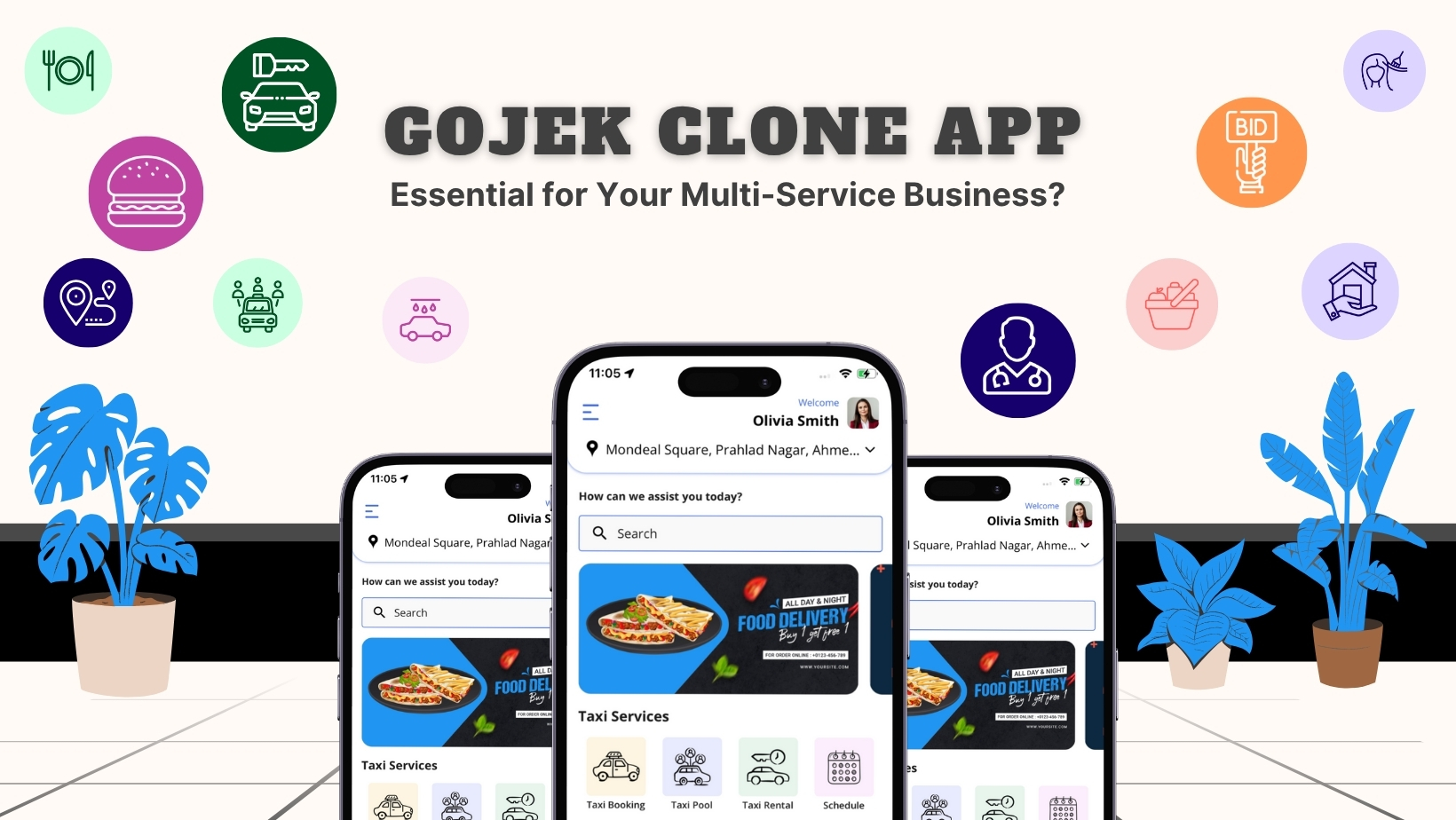
Introduction To Gojek-Like App In Singapore
If you are an entrepreneur or on-demand business owner in Singapore, 2026 is not a year to “wait and watch.” It is a year to execute smartly.
Yes, the market already has giants like Grab and Gojek. But here’s the strategic insight many business owners are realizing: large platforms are optimized for scale, not for neighbourhood depth. Merchants want better margins. Riders want fairer incentives. Customers want faster, more predictable service.
This is where a Gojek Clone model becomes powerful, not as a copycat, but as a focused, hyperlocal super app designed for Singapore’s unique ecosystem.
Let’s break this down properly, from strategy to scale.
Why 2026 is the Year Of Launching Gojek Clone in Singapore?
Singapore does not need another island-wide super app trying to replicate global giants overnight. What it needs are focused, efficient, hyperlocal ecosystems.
The original Gojek model worked because it bundled multiple services into one app. But if you want to Launch Gojek like app in Singapore, you must adapt that model to local realities:
- Strict compliance requirements
- High digital literacy
- Dense urban neighbourhoods
- Competitive pricing sensitivity
In 2026, speed, precision, and positioning matter more than size. If your goal is to build a super app in Singapore, think neighbourhood dominance first, expansion later.
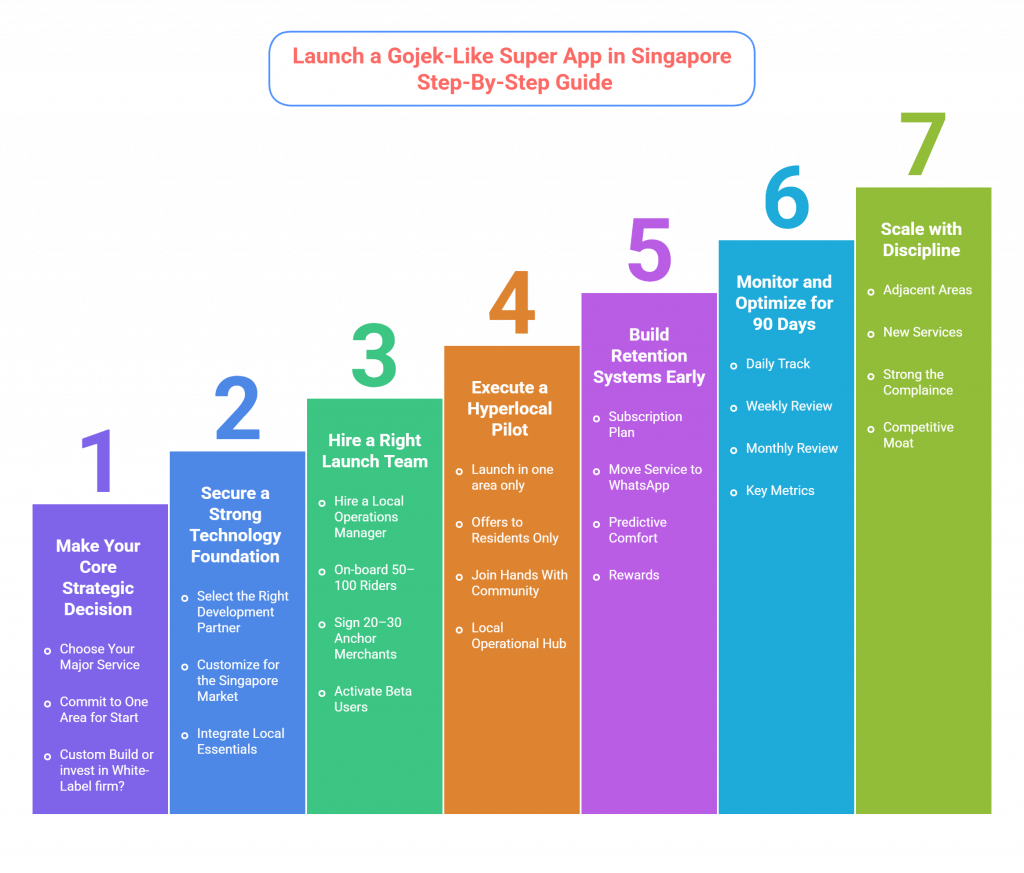
Step 1: Make Your Core Strategic Decision
Before writing the code or signing a contract, you must define your structure. Such as:
Choose Your Major Service
- Launch with More than 10 On-Demand Services
- Start with one basic service and add one or more over time.
For example, if you want begin with food delivery, add grocery and parcel delivery. These services share riders networks and logistic infrastructure.
If you begin with ride-hailing services and add a courier service or airport transportation. Operational overlap reduces costs and simplifies management. Entrepreneurs who want to build a super app like Gojek successfully focus on operational efficiency first and expansion second.
Commit to One Area for Start
Singapore is dense, but that does not mean you should launch island-wide. Select one neighbourhood, such as Tampines, Punggol, or Jurong East and concentrate all operations there.
For example, if you select Tampines, your riders operate within a tight radius. Your marketing focuses only on Tampines residents. Your merchant’s partnerships are highly concentrated. This hyperlocal app strategy improves delivery time, reduces fuel costs, and builds community recognition quickly.
Custom Build or invest in White-Label firm?
Custom building technology from the ground level may cost hundreds of dollars and take more than a year. In 2026, speed matters more than pride. Using a proven Gojek Clone App development allows you to enter the market within weeks. For most entrepreneurs, this is the smarter route.
A reliable solution already includes a user app, store app, driver app, admin panels, and essential backend systems. That allows you to focus on partnerships and operations instead of debugging software.
Step 2: Secure a Strong Technology Foundation
Technology is the backbone of building the App. If the foundation is weak, scaling becomes expensive and messy. So select each thing wisely.
Select the Right Development Partner
When building a Gojek Clone Singapore, your tech partner must deliver more than just the app. Look for a White-Label App Development Company like GojekAppClone that offers:
- Development in 1-2 weeks
- Android and iOS Apps
- Admin Dashboard
- Customizable Branding
- Scalable Backend
In Gojek-like App Development, automation, smart dispatch, and route optimization are standard, not premium add-ons. Expect to invest around SGD 30,000 for a reliable, scalable solution.
Customize for the Singapore Market
Your App must feel local, not generic. Adapt your branding, service names, commission model, and promotions to fit Singapore’s surroundings.
For example, a “Punggol Priority Delivery” with guaranteed 30-minute service instantly creates relevance and trust. Strong localization builds credibility faster than templates ever will.
Integrate Local Essentials
Singapore is compliance-driven. Your platform must integrate the following payment-related essentials:
- PayNow API
- Secure payment gateways
- PDPA-compliant data handling
- Accurate Singapore mapping systems
On-demand app compliance in Singapore is not optional. It protects your business and strengthens your brand.
Step 3: Hire a Right Launch Team
Technology powers the platform but people make it work. If you want your super app to succeed, your launch team must be strong from day one.
Hire a Local Operations Manager
Start with someone who truly understands your pilot neighbourhood. A manager based in Jurong East, for example, will know the merchants, local events, and customer behaviour far better than someone managing remotely. That local insight prevents costly mistakes and speeds up decision-making.
On-board 50–100 Riders
Focus on quality over quantity. Your riders must have proper licensing, insurance coverage, clear payout structures, and customer service training. If you plan to start an on-demand service in Singapore, remember, riders are your brand on the streets. Their professionalism directly impacts customer trust.
Sign 20–30 Anchor Merchants
Bring in recognizable neighbourhood names first. A well-known hawker stall or popular café can instantly attract loyal customers to your platform. Anchor merchants drive early downloads and help generate repeat orders.
Activate Beta Users
Before going public, test your system. Recruit at least 500 local residents to try the app and offer promo credits in exchange for honest feedback. This allows you to fix operational gaps and refine the experience before full launch.
Step 4: Execute a Hyperlocal Pilot
Your pilot phase determines long-term survival, so stay focused and strategic from day one.
Launch in one area only
Do not advertise island-wide. If you begin in Punggol, keep operations strictly within that zone. A tight geography improves delivery speed, rider efficiency, and service quality. Your goal should be clear: achieve at least 30% local market penetration before expanding.
Offers to Residents Only
Create exclusivity with residents-only promotions. Offer deals like free delivery for specific postal codes such as 56xxxx and 17xxxx. When people feel included, they engage more.
Join Hands With Community
Build offline credibility as well. Partner with Residents’ Committees, community centres, and sponsor local events. Attend weekend markets and stay visible. Physical presence builds trust faster than digital campaigns alone.
Local Operational Hub
At last, establish a small local operations hub. A physical coordination point improves operational control and strengthens merchant confidence. When you launch on-demand delivery app services, visibility directly improves reliability.
Step 5: Build Retention Systems Early
Acquiring users is costly. Retaining them is where profitability begins.
Subscription Plan
Introduce a subscription tier, such as a $9.90 monthly membership offering free delivery, priority dispatch, and exclusive merchant deals. Recurring revenue stabilizes cash flow and builds loyalty.
Move Service to WhatsApp
Enable WhatsApp ordering to simplify reorders. Many customers prefer messaging over navigating an app repeatedly. Convenience increases repeat usage.
Predictive Comfort
Implement predictive convenience. If customers order dinner every Friday night, send timely reminders or suggestions. Small prompts drive consistent engagement.
Rewards
Reward your partners as well. Offer bonuses for high ratings, rider referrals, and consistent service quality. When partners feel valued, customer satisfaction improves naturally.
Step 6: Monitor and Optimize for 90 Days
The first three months are critical. There are certain things you have to take care of, that are as follows:
Daily Track
Track performance daily, including ratings, delivery times, cancellations, and partner availability. This will help you fulfill the needs of your audience easily.
Weekly Review
Conduct weekly reviews to analyse repeat customer rates, most-used services, and merchant performance. If grocery delivery outperforms food delivery, shift your focus accordingly.
Monthly Review
Make monthly strategy adjustments. Remove underperforming services, improve weak areas, and scale strong categories.
Key Metrics
Keep a close watch on key metrics such as customer acquisition cost, daily active users, average order value, and partner retention. Your super app development Singapore journey must be driven by data, not emotion.
Step 7: Scale with Discipline
Expansion should follow proven success, not ambition. If you want to scale, then do it with discipline, and for that, follow these:
Adjacent Areas
Expand only to adjacent areas after achieving strong penetration in your pilot zone. If you dominate Tampines, move into Pasir Ris, not Orchard.
New Services
Add new services based on performance data. If courier services show strong growth during your pilot, expand that vertical next. Avoid launching services without clear demand evidence.
Strong the Complaince
Strengthen compliance as you grow. Ensure CPF contributions, proper insurance, and regulatory adherence are always in place. Compliance builds long-term credibility.
Competitive Moat
Your competitive moat is not pricing. It is subscription loyalty, community trust, predictive convenience, and strong partner relationships.
This is how a focused Gojek-like Super App in Singapore builds sustainable, long-term success.
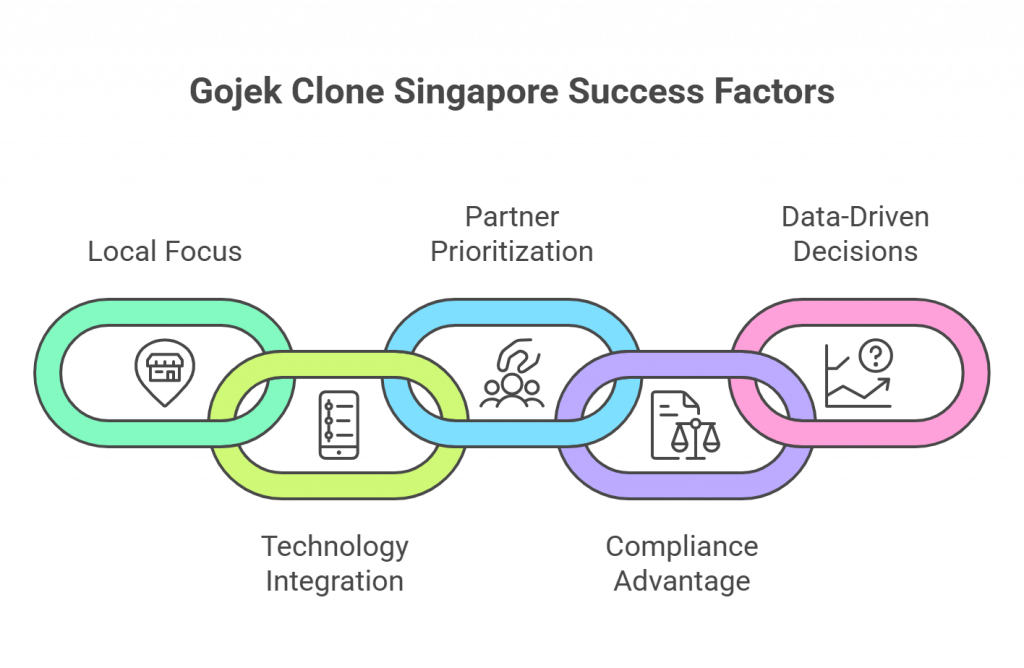
What are the Critical Success Factors of Gojek Clone App?
If you want your Gojek clone Singapore to succeed then follow these things:
- Start small and win locally.
- Use technology as a tool, not the solution.
- Prioritize partners before features.
- Treat compliance as a competitive advantage.
- Make decisions based on data, not assumptions.
What to Avoid While Development Your Gojek Clone App?
The following are certain things you should consider avoiding when building the App:
- Do not launch island-wide immediately.
- Do not custom-build complex technology in year one.
- Do not compete purely on rice.
- Do not neglect rider welfare
- Do not add services prematurely.
- Discipline protects your capital.
Checklist to Follow Before Going Live
Before taking your App into the market. There are certain things you need to check before:
- White-label provider selected
- Pilot neighborhood finalized
- Operations manager hired
- 50 riders onboarded
- 20 anchor merchants signed
- 500 beta users activated
- Compliance framework verified
- Marketing materials ready
- Customer support live
The metrics dashboard is operational. If these boxes are checked, you are ready to Launch Gojek like app in Singapore confidently.
Conclusion
Launching a super app in Singapore in 2026 is not about competing with giants. It is about executing smarter. A focused neighbourhood-first strategy, supported by a reliable white-label foundation and disciplined growth, gives you a realistic path to profitability.
If you want to build a super app in Singapore, move strategically, validate locally, and scale deliberately. Singapore does not need another massive platform. It needs well-executed, community-driven alternatives. With the right approach, yours can be one of them.
Frequently Asked Questions (FAQs)
Ans: Compete on convenience and loyalty benefits instead of cutting base prices. Subscription models help avoid destructive discounting.
Ans: Limit expansion, control marketing costs, use subscription revenue, and operate within one neighbourhood initially.
Ans:Track customer ratings, daily orders, cancellations, delivery times, and rider activity.
Ans: Assess scalability, compliance readiness, customization options, integration capabilities, long-term support, and upgrade flexibility.
Ans: Increase repeat orders through subscriptions and predictive features instead of adding new services.