Overview Of Gojek like Super Apps
Gojek is a South East Asian super app that’s been among the most popular NASDAQ stocks of the year. Gojek’s parent company GoTo has reported Rp13,295 Trillion (approx. $830 million) in revenue as of Q3 2025. Here lies an interesting insight: Gojek-like super apps are performing better than many single-service apps. And Gojek’s Customer Acquisition Strategies is no longer a hidden secret, their ‘Hyper-local’ marketing is famous around the world, inspiring countless super apps, including white-label Gojek clones.
If you’re running or planning your own super app in 2026, you’re at a strategic point where user behavior is leaning towards super apps. The reasons are:
- App fatigue: Users are overwhelmed by juggling multiple single-purpose apps.
- More rewards: Super apps bundle loyalty perks, discounts, and gamified incentives across services.
- Ecosystem convenience: One app handles rides, food, payments, and more—seamless and time-saving.
This is the moment to shine with your own Gojek clone. Now, just like every other application, having a user download an app can cost you, which is called the user/customer acquisition cost. These costs can be reduced effectively by understanding how successful apps like Gojek’s marketing strategy are. In fact, let’s go one step further.
After the acquisition costs, there are more costs associated with operating a Gojek-like super app, which include customer retention costs. The difference is simple, first, you bear the cost of acquiring (customer acquisition cost), and then to keep them using the app (customer retention costs).
So, how does the super app business model run? How do you reduce customer acquisition costs? How to maintain customer retention costs? If you have the same questions, this is the perfect place to discuss them. Let’s understand the top 10 cost-effective Gojek clone customer acquisition strategies that can work wonders for your super app business.
Customer Acquisition Strategies Key Terms & Metrics to Remember
Before we deep dive into the world of marketing strategies and understand how to reduce customer acquisition costs, you need to understand several terminologies and their meanings.
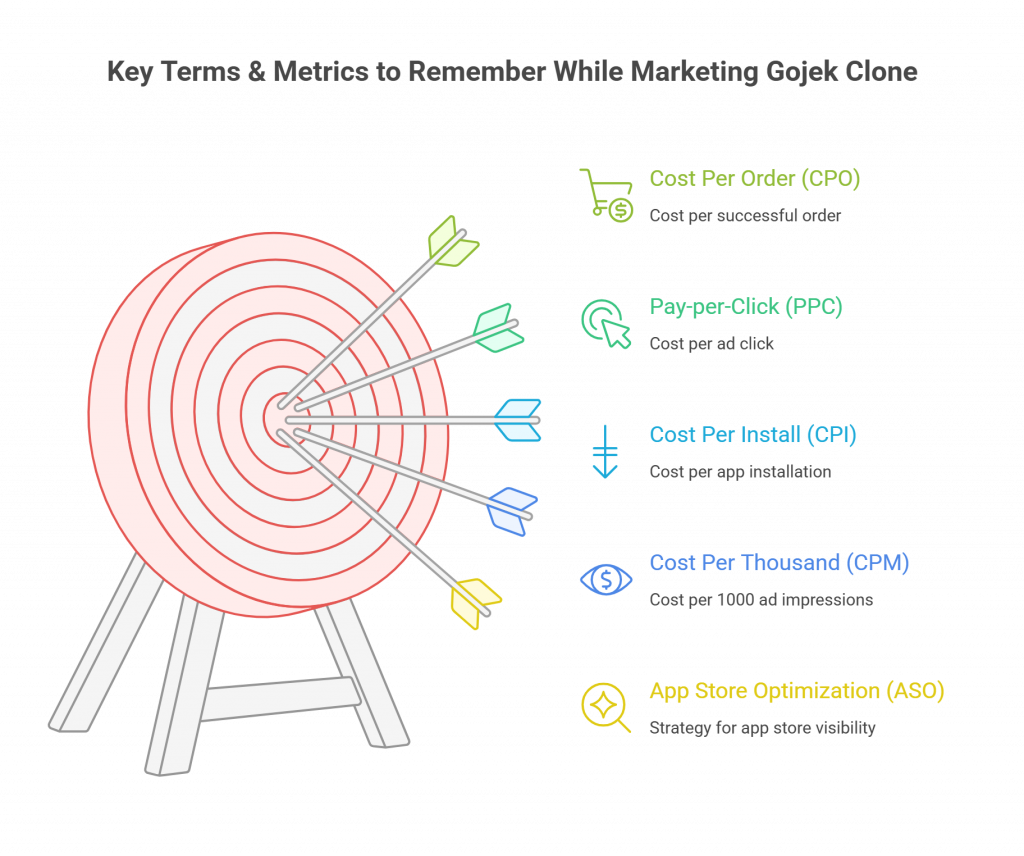
- Cost Per Thousand (CPM): It’s the amount you pay for every 1000 times your ad is displayed.
- Cost Per Install (CPI): It’s the cost you bear for every person who installs the app.
- Pay-per-Click (PPC): It’s a marketing model where you pay only if the person clicks on the ad.
- Cost Per Order (CPO): Cost Per Order is basically the cost you pay for marketing of every order that you get during a campaign.
- App Store Optimization (ASO): It’s a process of optimizing an app’s metadata and keywords to improve visibility on app stores and drive more organic downloads.
Now, let’s understand the strategies you can apply to your super app business model.
10 Advanced Customer Acquisition Strategies to Scale and Grow Your Gojek Clone App in 2026
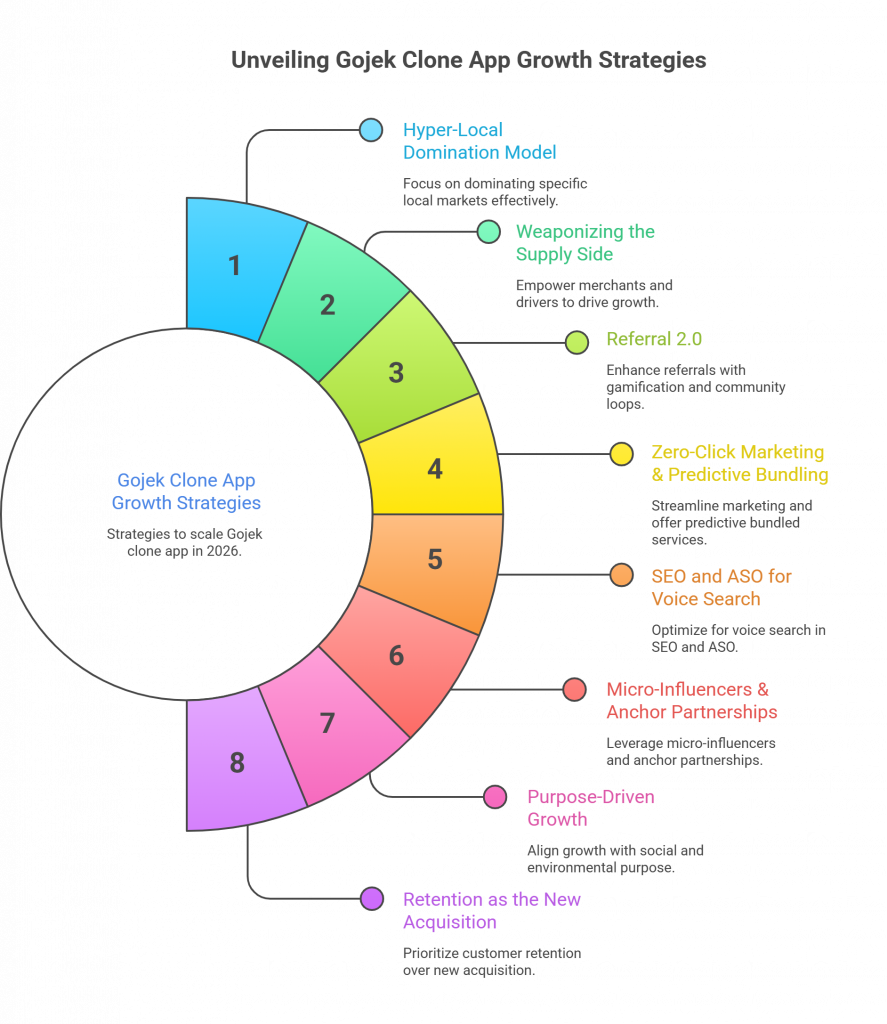
Strategy #1: The “Hyper-Local” Domination Strategy For Customer Acquisition
The hyper-local domination model is a marketing strategy that many super apps have been using. They secure market share by tailoring their services to specific localized areas, which includes discounts, understanding local preferences, and user behavior.
For Example, Grab a popular competitor of Gojek in Southeast Asia, provides many different services that are highly preferred in a specific neighborhood. Which means if there’s a neighborhood that orders groceries very frequently will have discounts for grocery shopping, while the person will not get the discounts if they leave the neighborhood and try it in any other locality. This way, specifically prioritizing the needs of the users is called Hyper-Local Domination.
Strategy #2: Weaponizing the Supply Side
This strategy focuses on solving the issues that supply channels actively face every day. This way, the supply chain automatically shifts to engaging the app and the consumers use it because the suppliers are already on the app. It’s one of the prominent Gojek clone marketing strategies.
Using this strategy, Rappi Developed a strong infrastructure which never leaves their side by following this simple step-by-step process:
Step #1 Providing Data Backed Insights: Rappi helped merchants to optimize their sales by providing insights from the daily user data. This creates a win-win situation for all: the customers, the merchants, and the entrepreneur.
Step #2: Optimizing the Resources: After Rappi showed proper data-backed insights, merchants entrusted the channel onto them. Through which they created systematic channels which optimized the resources invested on every order. They built a chain where distributors supplied to wholesalers and they could supply the retailers. The retailers (merchants), supplied to the app and the Rappi drivers were able to perform multiple deliveries at once.
This system helped in launching Latin America’s first Instant delivery module. Which was later adopted by the Indian Giant Blinkit.
Strategy #3: Referral 2.0 – Gamification & Community Loops Strategy
Unlike referral points, this strategy does not reward every person equally. Instead, it rewards higher as people get towards more invites. The admin has to create several milestones. Unlocking them, a user can get more rewards based on the tier they are on. This turns invitations into a game which decreases the CPI actively by investing in one install. The user will share the app to its whole community to get higher milestones and better rewards, which will get you free downloads at the cost of 1 installation.
For example, GoPay, a payments app by Gojek, marketed their payment box with a simple idea. They added rewards for merchants who referred other merchants to get the box and got discounts on their payment box. While for users they applied the same strategy. They offered free coupons on referral and downloads for their Gojek ride-hailing app. Indonesians use Gojek everyday, they happily downloaded the app and got 190 million downloads across South-East Asia as of today.
Strategy #4: Zero-Click Marketing & Predictive Bundling
The idea of Zero-Click Marketing is simple and very effective. Using the data and user history, app can predict what services the user takes interest in. If the consumer repeatedly orders chicken momos and also adds a coke. The app can identify this repetitive order effectively and then predictive bundling comes to the game. You make a bundle which adds chicken momos, diet coke, and predictively think of a french fries with it or a chilli oil dip. This increases the chances of the user to order the bundle and perceive a higher order value.
Many different Super apps use this strategy to get faster growth in order value through the personalization feature. On top of it, the feature also acts by sending notifications about the bundles and shows it every now and then to the user so that the user orders effortlessly and reduces the cost per order during campaign marketing.
Strategy #5: SEO and ASO for the “Voice Search” Era
Today, people search using Voice search, which means, they have been more descriptive and asking more questions, instead of typing specific keywords. This includes every search engine that exists and also the AI models which are the talk of the town today. People regularly search for different services which they need for daily life, such as “near me” or “best” queries. If you’re able to concretely rank on these queries with SEO and ASO, it’s the best strategy for long-term customer acquisition and retention.
SEO & ASO keeps discovery pipelines filled. A super important metric to notice here must be the cost you bear for each install, which is CPI. With SEO & ASO teams offering lower costs than paid marketing channels. However, having both organic and paid marketing with PPC creates balance, taking the ROI to sky high. So, SEO and ASO are one of the most important Gojek clone marketing strategies which you can focus on for long term growth.
Strategy #6: Micro-Influencers & “Anchor” Partnerships For Young Customer Acquisition
In this new age of social media, influencer marketing and its strategic value cannot be ignored. Having influencers based on your budget is the best way to approach the market with trust and value. An influencer promotes your Gojek clone with utmost authenticity, while their audience is deeply engaged with them, so in turn it reduces the customer acquisition costs when ads can’t create trust signals.
For example, Grab collaborated with Max Klymenko, a Youtuber + Instagram influencer, he hosted the founder on his famous Career Ladder show, and orchestrated how marketing has changed. New gen marketing is deeply connected with influencers and their raw, authentic way of marketing.
Watch the Career ladder episode here:
https://www.instagram.com/reel/DQ2lNEZjPi6/?utm_source=ig_web_copy_link
Strategy #7: Purpose-Driven Growth Strategies
Today, consumers don’t just acquire services from anyone. People need purpose, and the story behind your product. If your Gojek clone marketing strategy includes a purpose which is clear and impactful people are ready to acquire from you.
For example, Gojek’s Marketing Strategy actively announces sustainability as a part of their act every now and then. The marketing team invests in insurances, EV adoption, and much more environmental conservation talks across South-East Asia. This is why many people only ride with Gojek even if Grab is cheaper in Singapore and Thailand. As they are vocal about social responsibility, a purpose that connects with the audience. This transactional loop is very beneficial in Customer Retention costs, as its gets lower and increases order value during campaigns.
Strategy #8: Retention as the New Acquisition
With so many choices and options, retention is becoming harder for super apps. This state is generally known as choice paralysis. It’s a state where you cannot make a choice because of the options enabled. That’s why retention costs are surging.
Now, the retention costs can be lowered with campaigns that push users to order by offering specific discounts. For example, Careem, Rappi and Amazon Now, use this very simple technique called ‘Upselling or Threshold rewarding strategy’, where they provide free deliveries if the order value goes above X amount. In other words, let’s say you order 2 hamburgers from Doordash, and it shows, if you add fries with it you get a coke free. There’s a good chance that you’ll take this offer. The sunk cost effect increases order value and the customer keeps ordering again believing that they got a discount.
Moreover, Gojek’s marketing strategy dominates the mind with a simple lock in. With their Gopay payments app, they offer a seamless fintech layer which often restricts the users to shift from one app to another. By adding an in-App wallet you can also get a similar retention effect.
Strategy #9: “Try-Before-Install” App Experience Strategy
Test-Before-Install experience lets users test a smaller version of the app prior to signing up for a full download. Platforms like Google Play Instant Apps and Apple App Clips let users quickly access a particular feature or service, without installing the whole application.
In the case of super apps like Gojek, this method minimizes the friction of the user experience. Instead of making users download the app and then experience the core services like taking a taxi or making a food order. When users realize the value of the service, the move to a full installation is significantly easier.
From a marketing standpoint, this strategy has the potential to significantly improve the rate of conversion to installs and lower Cost Per Installation (CPI). In letting users try the service before they commit to purchase, businesses will be able to attract more serious customers and increase the long-term retention of customers.
Strategy #10: WhatsApp & Conversational Commerce Acquisition Strategy
WhatsApp is trusted because of its encryption and now when the brands have started offering their services on it, your super app can do it too. Today, many businesses run through WhatsApp, and deploying an AI-powered chatbot can be very beneficial. The user types I want to book a taxi and it just books a taxi for the user. This is where the market flows.
Having such features, giants like Uber, have dominated the LLM conversations and WhatsApp chats strategically. Today, WhatsApp bots and ChatGPT book a taxi for the user, having such convenience is very rare, very straightforward, and simply anchor you as the best in the town. So, ensure to add WhatsApp Chatbot, it can increase business growth by 2-3x if used strategically.
Gojek Clone Marketing Budget Breakdown: Where to Spend Your First $10,000
Knowing about strategies isn’t enough though. Understanding finances is a major part of dealing with unit economics. Thus, your Gojek clone customer acquisition strategy must implement it with actual understanding of budget allocation. For a smart entrepreneur investing the first $10k is the most important while aiming for the best ROI.
Now, to get the best ROI, many people prefer the hit and trial method, but the fact is it is expensive and you haven’t won a billion dollar lottery. That said, you cannot invest in marketing blindly. That’s why you should use what has already worked for successful apps. It means implementing Gojek clone marketing strategy with best ROI channels like Hyper-localized discounts, SEO & ASO, and the referral system. If you’re still in the development phase, don’t forget to invest money in WhatsApp chatbot for long-term growth. White-label companies like Gojek App Clone, provide WhatsApp Chatbot integration with their super robust Gojek clone in just 2 weeks.
Budget Allocation ( How to Spend Strategically)
| Marketing Channel | % Split | Budget $5K | Budget $10k | Budget $25k | Best For |
| ASO & Advertisement | 50% | $2.5k | $5k | $12.5k | Early Validation and Organic Discovery |
| Hyper Local Discounts | 30% | $1.5k | $3k | $7.5k | First-City Launch and Rapid User Acquisition |
| Referral System | 20% | $1K | $2k | $5k | Multi-City Expansion and Community Growth |
Conclusion: The Next Step Awaits!
Growing a super-app isn’t just about creating several services. It’s about developing an efficient growth strategy that continually attracts and entices customers. A successful Gojek clone’s marketing strategy is focused on reducing the cost of acquisition while maximizing the value of long-term customers.
Strategies such as hyperlocal expansion, driver and merchant relationships, referral loops and predictive personalization can help startups build a strong growth engine. In the same way tools for retention like loyalty rewards such as in-app wallets, and even conversational commerce, ensure that customers keep coming back.
Companies such as Gojek, Grab, and Uber have grown through smart acquisition and solid retention networks.
If you are developing a Gojek clone for 2026 or later, the potential is in implementing these strategies that are cost-effective to build an extremely user-friendly, scalable app that is able to expand across all markets.
Frequently Asked Questions By Gojek Clone App Owners Who Want To Increase Customer Acquisition and Grow Their Own Gojek Like App
Answer: The most cost-effective strategy is Try Before Install experience, it can be set up while deploying the apps, and then you don’t have to invest a lot in customer acquisition.
Answer: Yes, even Gojek’s marketing strategy included hyper-local strategies and it has helped them cater to users’ specific needs.
Answer: Yes, a ready-made Gojek clone solution provides exact frameworks you need at much economical investment. This means that you save money on development and you can use it in marketing your app.
Answer: Yes, Many micro-influencers have an authentic audience who connects and trusts them intensely, it can help you drive measurable ROI for your Gojek clone customer acquisition strategy.
Answer: Zero click marketing means to understand the intent of the user and provide him bundles and offers which they’ll be interested in. By predicting the behavior of users through data, you can pile up different things and offer them a bundle, which increases order value at less CPO.
Answer: A hyper-local acquisition strategy is deeply connected to discounts and consistent order values, which can help you acquire a consumer faster on the price-breakpoint and then retain them by consistently offering discounts which increase repeat orders.
Answer: Social Media has been more in use than ever before. While Influencers, SEO, ASO, and different gojek clone marketing strategies work wonders, investing in Meta & Google Ads can still significantly drive revenue in 2026. You just need to be strategic about it.